What Were the Consequences of the Shutdown?
The economic impact of internet shutdowns can be analyzed from several different perspectives.
۱. From the Perspective of Everyday Businesses
For a variety of reasons—including lower operating costs, increased market reach, and higher sales—many retail stores and small businesses have gradually embraced e-commerce and digital business models.
If we consider the following model to represent approximately ۹۰% of the general consumer economy, it becomes clear that internet-related spending has become a normal part of both household and business budgets.
In today’s digital economy, consumers and businesses alike allocate a portion of their financial planning to online commerce. As a result, although digital trade has become deeply integrated into everyday economic activity, prolonged internet shutdowns disrupt carefully planned business operations, interrupt online sales channels, reduce customer engagement, and create uncertainty for businesses that depend on digital platforms.
Although allocating part of the household budget to e-commerce has become a common practice, internet shutdowns can quickly disrupt carefully planned business strategies and consumer spending patterns, creating uncertainty for both businesses and customers.
۲. From a Macroeconomic Perspective
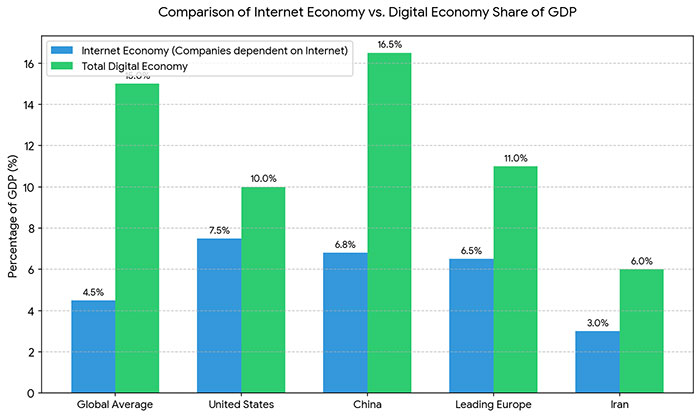
To understand the broader economic impact, it is essential to examine Chapter 13 of Iran’s Seventh Five-Year National Development Plan, which sets a target for the digital economy to account for 10–۱۵% of the country’s GDP by the end of 2028 (1407 in the Iranian calendar).
Even before internet disruptions, achieving this objective faced numerous obstacles, including budget imbalances, energy shortages, limitations in digital infrastructure, and challenges within the banking sector.
However, following a ۱۰-day nationwide internet shutdown in February 2026 (Bahman 1404), the sector experienced another major setback. According to the Deputy for Digital Economy at Iran’s Ministry of Information and Communications Technology (ICT), the digital economy’s contribution to GDP declined from ۴.۷۲% to approximately 4%.
Undoubtedly, the occurrence of two military conflicts and various social events during the same year also affected Iran’s economy. Nevertheless, prolonged internet disruptions significantly reduce the country’s ability to achieve the digital economy targets outlined in its national development strategy.
۳. What Were the Consequences of the Internet Shutdown?
The consequences of the internet shutdown can be examined from several different perspectives.
a. From the Perspective of the General Economy
It is well known that, for various reasons—including reducing costs and increasing sales—most stores and businesses have gradually shifted toward the modern world of e-commerce.
If we consider the following model to represent ۹۰% of the public economy, it becomes evident that, in today’s digital economy, internet-related expenses have become an integral part of household and business budgets.
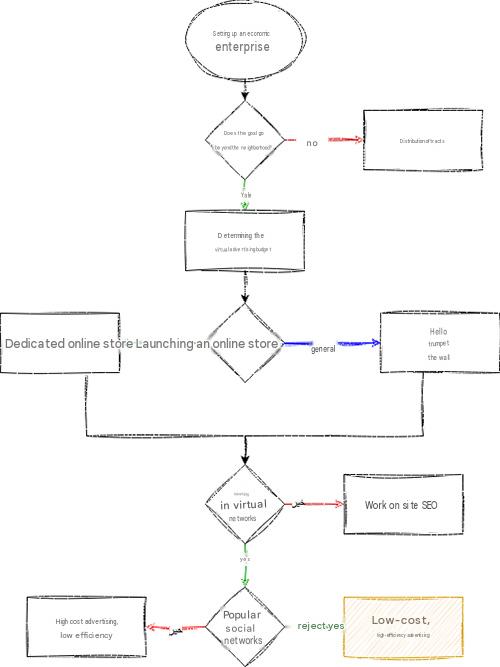
As a result, despite the fact that the culture of allocating a budget for e-commerce has become deeply rooted among the general public, an internet shutdown can easily disrupt carefully planned financial and business strategies.
b. From the Perspective of the Macroeconomy
To better understand this issue, we should refer to Chapter 13 of Iran’s Seventh Five-Year Development Plan. According to this national development plan, the digital economy’s share of GDP is expected to increase to ۱۰–۱۵% by the end of the Iranian year 1407.
Even before the shutdown, this sector faced numerous challenges, including budget imbalances, energy shortages, data center limitations, and banking-related issues.
However, following the ۱۰-day internet shutdown in Bahman 1404, the sector experienced another major setback. The Digital Economy Department of the Ministry of Information and Communications Technology announced that the digital economy’s contribution to GDP had declined from ۴.۷۲% to approximately 4%.
Undoubtedly, the occurrence of two wars within a single year, together with the social events of 1404, created numerous economic challenges for the country. Nevertheless, a prolonged internet shutdown would significantly reduce the likelihood of achieving the objectives outlined in the Seventh Development Plan.
c. From the Perspective of the Knowledge-Based Economy
When we examine the defining characteristics of knowledge-based companies—namely innovation and advanced technology—we realize that these organizations, despite their delicate structure, are continuously pushing the boundaries of a technology-driven economy.
Unlike many traditional industries, operational stability is the primary requirement for knowledge-based companies, while capital is only the second critical factor.
Another important point that often receives little attention is that establishing a successful knowledge-based company may take up to a decade. Even if sufficient funding and a stable business environment exist, the highly skilled individuals capable of implementing innovative ideas may no longer be available.
Like other segments of the digital economy, knowledge-based businesses were severely affected by the internet shutdown. Companies that had previously managed to survive despite numerous challenges, thanks to a relatively stable operating environment, suddenly found themselves deprived of one of their most essential resources—the internet. As a result, many moved from a fragile position toward potential collapse.
It is also worth noting that, despite the increasing number of knowledge-based companies, the contribution of knowledge-based products to Iran’s GDP has declined to ۰.۵۵%. This is largely because most newly established companies operate in software and information technology, sectors that rely heavily on internet connectivity as a fundamental production resource.
Overall, it can be argued that repeated internet shutdowns may significantly delay Iran’s progress and competitiveness in the development of a knowledge-based economy.
d. Who Were the Winners?
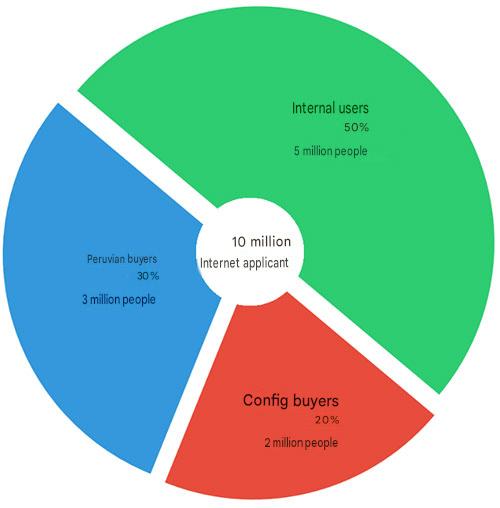
Since obtaining accurate and up-to-date statistics in Iran is often difficult, let us make a simple estimate based on ۱۰ million internet users. Even a rough calculation produces some remarkable figures.
- Internet Pro entered the market relatively late but reportedly captured around ۳۰% of users, generating an estimated revenue of ۵ Hemmat.
- Assuming that approximately ۲۰% of users turned to configuration (Config) services, vendors in this market are estimated to have earned between ۱۰ and 18 Hemmat.
- Assuming the remaining ۵۰% migrated to domestic platforms, those platforms are estimated to have generated between ۴ and 6 Hemmat in additional revenue.
Although these figures are unofficial and based on rough estimates, they provide a useful perspective on who may have benefited economically from the internet shutdown.
e. A World That Did Not Wait for Us
Technological progress is advancing at an extraordinary pace. During the very three months in which we were waiting for domestic networks to return to normal and struggling to send even a simple email, the global technology landscape experienced major developments.
- Anthropic introduced the Mythos model, an AI system capable of identifying and analyzing a significant portion of cybersecurity vulnerabilities across digital platforms.
- OpenAI released GPT-5.5, a far more powerful and faster AI model that is expected to drive another major wave of technological innovation.
- Alibaba launched its advanced Qwen 3.7 Max model, which officially reached the fifth position among the world’s leading AI models within just three months.
Conclusion
In conclusion, one cannot help but wish that the knowledge-based economy had an independent international governing body—similar to FIFA in the world of football—that could shield technological innovation from political influence and allow it to develop solely on the basis of science, innovation, and fair competition.