What Is Smart Livestock Farming? And Why Should Iran Move Toward It?
Summary
Iran’s livestock industry is facing growing challenges related to production costs, product quality, exports, and the efficient use of resources and operational processes. Following the Fourth Industrial Revolution (Industry 4.0), technology has advanced to a level where even complex production processes can be managed through simple, scalable, and data-driven solutions.
Smart Livestock Farming is the integration of standardized data, the Internet of Things (IoT), and Artificial Intelligence (AI) into herd management, livestock production, feeding, and workforce management. These technologies should not be considered optional tools, but rather as the infrastructure required to enhance competitiveness and reduce production costs.
Challenges Facing Iran’s Livestock Industry
The livestock sector in Iran is currently confronted with several major challenges, including:
- High production costs and increasing pressure on producers’ profit margins.
- The need to build trust in product quality and expand exports to international markets.
- Improving efficiency in two key areas:
- Resource consumption (water, electricity, fuel, etc.)
- Production structures and operational processes (from farm to factory)
Traditional approaches, such as increasing physical investment without relying on data, often result in higher costs without guaranteeing systematic improvements. In contrast, Industry 4.0 has demonstrated that the combination of automation, data, and analytics can simultaneously reduce costs and make quality measurable and fully traceable.
A Key Principle: Without Data, a Technology Ecosystem Cannot Be Built
To solve the challenges of the livestock industry, technology companies must be encouraged to enter this sector. However, three fundamental prerequisites are entirely data-driven:
- Attracting data and analytics specialists
- Attracting investment in livestock technologies
- Encouraging technology companies to develop solutions for the livestock industry
Without standardized, shareable, and interoperable data, all three objectives become slow, difficult, and costly. Investors are reluctant to accept risk, data specialists cannot create value without a proper data foundation, and technology companies cannot build scalable solutions without APIs and standardized data models.
What Is Smart Livestock Farming?
Smart Livestock Farming is a collection of technologies and solutions that leverage real-time data and modern technologies—including IoT, Edge Computing, Cloud Computing, and Artificial Intelligence—to improve livestock production processes.
Its primary objectives include:
- Reducing production costs
- Increasing operational efficiency
- Improving quality traceability
- Supporting data-driven decision-making
These technologies enable livestock operations to move from traditional management toward intelligent, predictive, and integrated management systems capable of delivering higher productivity and greater sustainability.
Operational Classification (Two Domains)
To facilitate the design of IoT architecture and integrated databases, Smart Livestock Farming is divided into two operational domains:
| Domain | Main Components |
|---|---|
| Animal-centric | Animal health, identification, automatic scoring, animal welfare, automatic milk recording, automatic body temperature recording, and digital animal records |
| Farm-centric | Feed and inventory management, herd performance, milk management (storage tanks, herd consumption, delivery to the dairy plant), environmental monitoring (THI, ammonia, CO₂), genetics, and other production-related systems |
This classification supports the development of IoT infrastructure and data architecture. Each subsystem generates operational events and data, which are then integrated into a unified herd management data model.
Modiran Company’s Roadmap: From Strategy to an Integrated Smart Livestock Farming Solution
To address the livestock industry’s data challenges, Modiran has adopted an Industry 4.0 approach and developed a practical roadmap toward Smart Livestock Farming.
The company’s strategy includes:
- Establishing the foundations of Smart Livestock Farming.
- Collaborating with selected technology companies to design and develop IoT devices, including feeder controllers, portable data collection systems, environmental sensors, actuators, and related equipment.
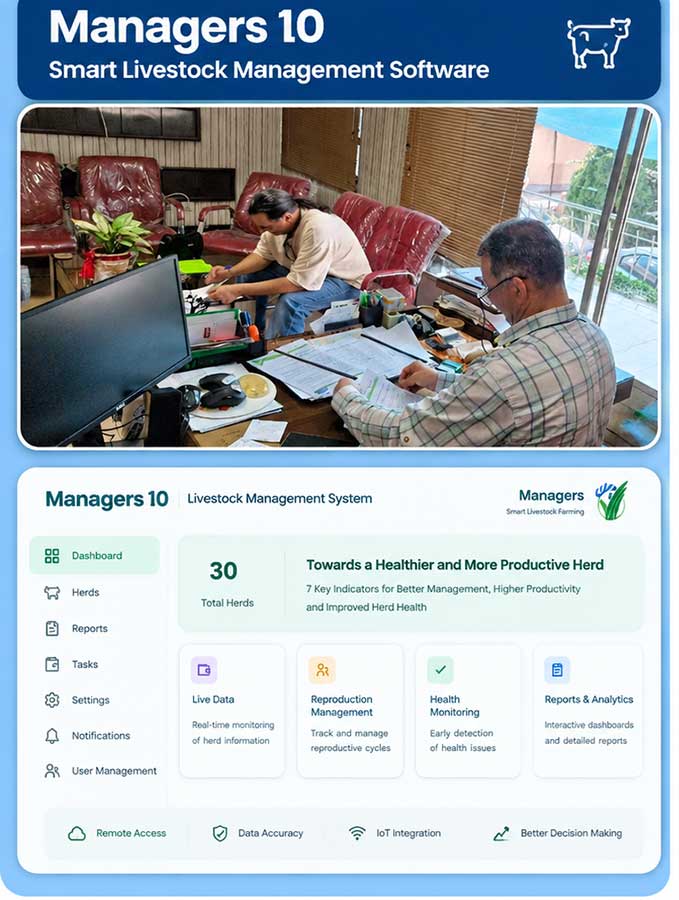
- Developing a fully integrated Smart Livestock Farming package that connects software, IoT technologies, and Artificial Intelligence into a unified platform.
Components of the Smart Livestock Farming Package
۱. Open-Source Databases
The platform includes several integrated databases designed to support operational and strategic decision-making:
- Herd Management
- Cost of Production
- Nutrition Management
- Forecasting and Scenario Analysis
These databases provide standardized, structured, and shareable data for analytics, reporting, and integration with emerging technologies.
۲. Animal-Centric IoT
The animal-focused IoT infrastructure includes:
- Animal identification systems
- Automatic body condition scoring
- Automatic weighing systems
- Animal welfare monitoring
- Smart cooling systems
- Feed requirement assessment
- Automatic body temperature recording
- Automatic milk recording
- Portable access to digital animal records via mobile devices and displays
- Smart sorting gates
- Additional animal monitoring subsystems
These technologies automate data collection while improving animal health, productivity, and management accuracy.
۳. Farm-Centric IoT
The farm-focused IoT infrastructure covers all major production operations, including:
- Feeding management
- Herd performance monitoring
- Milk management
- Milk storage tanks
- Herd milk consumption
- Milk delivery to processing plants
- Environmental monitoring
- Temperature
- Humidity
- Temperature-Humidity Index (THI)
- Light intensity
- Ammonia concentration
- Carbon dioxide (CO₂)
- Feed inventory management
- Genetic performance indicators
This integrated monitoring system enables real-time visibility into every critical aspect of livestock production.
۴. Artificial Intelligence (AI)
Artificial Intelligence serves as the analytical engine of the Smart Livestock Farming platform by providing:
- Continuous learning from herd performance data
- Benchmarking against industry standards
- Intelligent recommendations for operational improvement
- AI-powered assistants (voice and visual)
- A one-year livestock farm simulation model for forecasting future performance and evaluating management scenarios
AI transforms raw operational data into actionable insights that support faster and more informed decision-making.
۵. Smart Workforce Management
Smart Livestock Farming also includes intelligent workforce management features designed to improve operational performance through:
- Planning and delivering standardized process training
- Comparing employee performance with predefined operational standards
- Automatic staff performance ranking
This ensures that human resources evolve alongside technological advancements, leading to higher efficiency and more consistent operational quality.
Should Iran Move Toward Smart Livestock Farming?
The answer is yes—if the objective is to reduce production costs, strengthen regional competitiveness, and attract advanced technologies.
Smart Livestock Farming is not merely about investing in expensive hardware. More importantly, it provides an open, data-driven platform that lowers the barriers for technology companies to enter the livestock industry while offering transparent Key Performance Indicators (KPIs) that increase investor confidence and create sustainable competitive advantages.
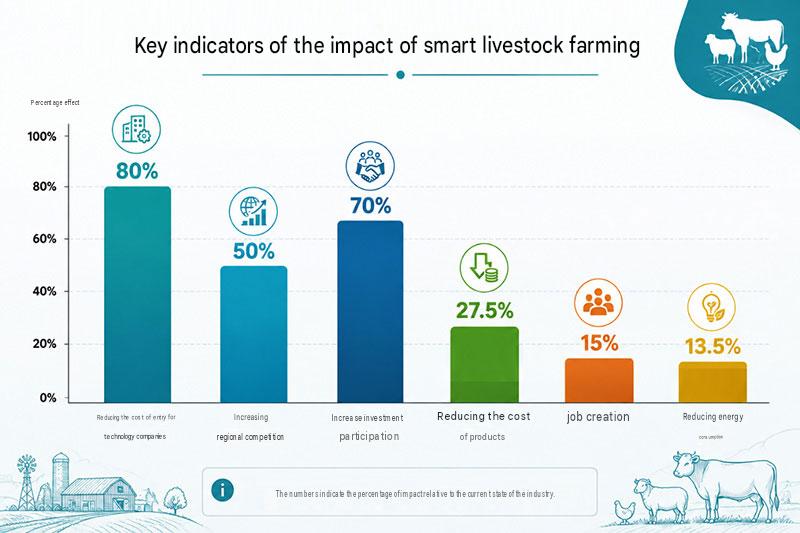
Based on internal modeling, pilot projects, and industrial benchmarking conducted throughout the development of this approach, the estimated benefits of implementing Smart Livestock Farming through phased deployment and integrated data management are as follows:
| Indicator | Estimated Improvement |
|---|---|
| Reduction in technology companies’ entry costs into the livestock industry | Approximately ۸۰% |
| Increased competitiveness with regional countries | Approximately ۵۰% |
| Increased investor participation in the livestock industry | Approximately ۷۰% |
| Reduction in livestock production costs | ۲۰–۳۵% |
| Employment growth (Data, IoT, and digital services ecosystem) | Approximately ۱۵% |
| Reduction in energy consumption | ۷–۲۰% |
These figures demonstrate that Smart Livestock Farming can generate measurable economic and operational value while supporting the long-term digital transformation of the livestock sector.
 Conclusion
Iran’s livestock industry should not rely solely on expanding its physical production capacity. Instead, it should consider data infrastructure, the Internet of Things (IoT), and Artificial Intelligence (AI) as strategic components of its national and industrial development agenda.
Creating standardized and integrated data infrastructures enables technology companies, investors, researchers, and livestock producers to collaborate within a common ecosystem. This ecosystem will accelerate innovation, improve productivity, enhance product quality, reduce production costs, and strengthen the international competitiveness of Iran’s livestock industry.
Smart Livestock Farming is not simply a technological trend—it is a strategic necessity for building a sustainable, competitive, and data-driven livestock industry.